
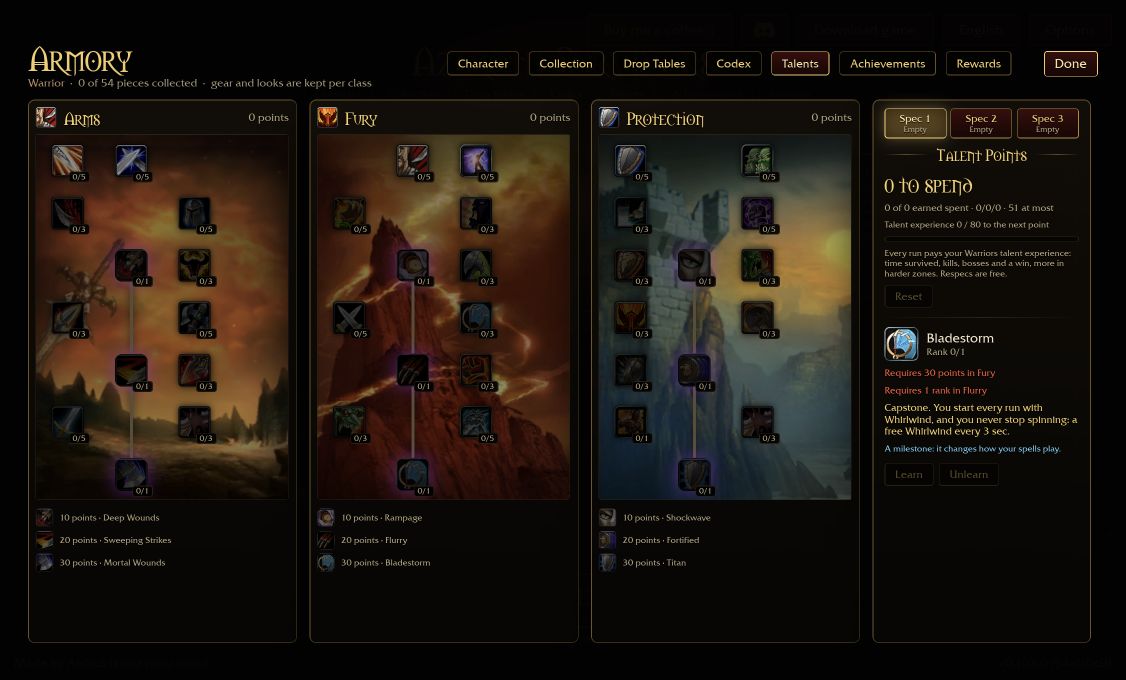
The Whirlwind build starts in the Fury talent tree
Open the Warrior’s Talents panel and look at Fury. The three linked milestones are Rampage, Flurry and Bladestorm. They change how the class uses Whirlwind rather than merely adding another damage number. In the original game menu checked for this guide, Bladestorm makes Whirlwind your starting spell and adds a free Whirlwind every three seconds.
| Talent | Requirement shown in the menu | What it adds |
|---|---|---|
| Rampage | 10 points in Fury | Every seventh kill triggers a free Whirlwind. |
| Flurry | 20 points in Fury and one rank in Rampage | Whirlwind and Bloodthirst hit again immediately for 40% of the original blow. |
| Bladestorm | 30 points in Fury and one rank in Flurry | Start each run with Whirlwind, plus a free cast every three seconds. |
These are the requirements displayed by the tree, not a promise that a new character already has those points. The checked character had zero points available. Use the point counter and the requirement text before trying to learn a milestone; the connecting line does not bypass its gate.
What to do before Bladestorm is unlocked
A fresh Warrior in the checked character screen starts with Cleave. That matters when a build video opens with continuous spinning: the player may already have the final Fury talent. Your early run can still use nearby damage and careful movement, but it is not yet the same setup.
Choose a zone you can enter, start the run and judge the cards that actually appear. If Whirlwind is offered, it gives you a way to investigate the close-range plan before committing your later talent points. Do not repeatedly restart just because an early draft does not contain every spell from someone else’s finished character.
The talent panel says Warrior runs earn class talent experience from survival time, kills, bosses and wins, with more in harder zones. It also says respecs are free. That makes a repeatable run useful: learn where your current attempt breaks down, then return to the tree with a specific question instead of copying an inaccessible end-game layout.
Choose the next card for the problem in front of you
Once your Whirlwind route is active, separate three problems. Enemies surviving a pass suggest that damage or attack frequency deserves attention. Enemies reaching you outside your coverage suggest checking area and positioning. Losing too much health despite adequate damage means another offensive card may not solve the run.
| What ends the attempt? | A useful next comparison | What to watch |
|---|---|---|
| Small enemies close the ring around you. | Compare an offered area upgrade with another damage-only pick. | Can you pass the edge of the pack without entering its centre? |
| Enemies remain alive between attacks. | Read the offered damage and cooldown changes. | Does the next pass leave fewer pursuers, or the same gap? |
| You reach the wave but cannot leave it safely. | Consider an offered defensive or movement benefit. | Can you keep an exit open long enough to recover? |
These comparisons are a suggested way to evaluate your cards, not measured rankings. A card’s actual wording, your equipment and your unlocked talents determine what changes. The same spell name in a community reconstruction does not establish identical behaviour in this release.
Keep a route through the edge of the wave
Whirlwind damages enemies near the Warrior. That is a reason to plan where enemies approach, not a reason to stand in the densest part of the crowd. Move around the outer edge, allow pursuers to gather, and leave a direction you can still travel before another group arrives.
Pick up experience when the path is safe. Crossing a packed centre for one drop can undo a good sequence of upgrades. After a failed attempt, keep one short note: the spell choices, the talent route and the situation that trapped you. Change one important choice on the next attempt so the result tells you something useful.
The original desktop menu lists WASD or both mouse buttons for movement and 1, 2 or 3 for card choices. Click the game window to give it focus. If the menu or world does not load, use the loading help; changing a build cannot fix a blocked source or missing graphics support.
When the Titan route is worth comparing
If surviving close contact is the persistent problem, compare Protection rather than assuming Fury is mandatory. The Titan capstone in the checked menu requires 30 points in Protection and one rank in Fortified. It changes the starting spell to Shield Slam, raises the possible damage-reduction ceiling from 60% to 70%, and gives spells additional damage based on maximum health. Shield Slam also gains a component based on the target’s maximum health.
Titan is an alternative talent plan, not an upgrade to combine casually with an unfinished Fury route. Read the available point total and prerequisites. Compare it under similar zone and progression conditions, and judge whether you survive the difficult moment more reliably. This guide does not claim a fastest clear or a guaranteed best build.
Warrior build questions
Why does my Warrior start with Cleave instead of Whirlwind?
The fresh Warrior screen checked here starts with Cleave. Bladestorm changes that start after its Fury requirements are met. A video with Whirlwind from the first second may show an already-developed character.
Is Flurry the same as Bladestorm?
No. Flurry adds a second hit to Whirlwind and Bloodthirst. Bladestorm changes your starting spell and adds a repeat Whirlwind cast. The tree lists different requirements for the two talents.
Does this guide describe the open-source reconstruction?
No. The talent effects and gates on this page were read from Aethus’s original browser game, v0.103.0 (94afa0c0), on 20 October 2026. They are menu observations; a complete run or win rate was not tested.
Can I follow this build on a phone?
The build choices apply only after the game has started. The original host controls device and graphics support. Use the loading help first, or choose a touch-ready game if your device cannot start this project.
Sources and version
Talent names, gates and effects were read directly in Aethus’s original browser game, v0.103.0 (94afa0c0), on 20 October 2026. The route and card-choice advice are editorial suggestions, not measured clear times or win rates.