
Choose a build for the way enemies reach you
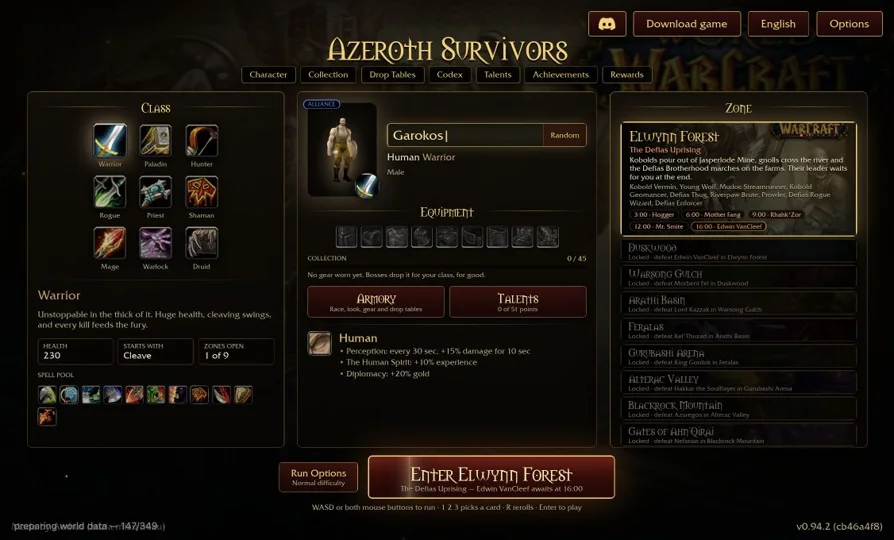
Before choosing a class, decide whether you want to fight close to the crowd or keep a little distance. The public community reconstruction starts Warrior with Cleave and Paladin with Hammer of Wrath. Their upgrade pools then give them different ways to deal with surrounding enemies. These are useful starting points for comparing the cards on your screen.
Read this as a source-backed planning guide. We checked the community reconstruction at commit dd5e330 on 19 October 2026. It is separate from Aethus’s live browser release, whose current skills and balance can differ. Match a skill’s name and effect to the card actually offered in your game before following a combination. The recommendations below are editorial interpretations of those mechanics.
| Class | Starting approach | Build direction to consider |
|---|---|---|
| Warrior | Cleave hits nearby targets. | Close-range coverage with Whirlwind; space from Thunder Clap; a finisher such as Execute when available. |
| Paladin | Hammer of Wrath reaches enemies from a distance. | A damage area from Consecration; control from Hammer of Justice; a defensive window from Divine Shield. |
Warrior build: make close-range damage safer
The Warrior pool in the checked source includes Cleave, Heroic Strike, Whirlwind, Thunder Clap, Sweeping Strikes, Demoralizing Shout, Execute, Mortal Strike and Retaliation. That gives you several ways to strengthen a melee plan. You do not need to chase every name at once: first identify whether small enemies surround you, targets survive your passes, or incoming damage leaves no room to recover.
Cleave and Whirlwind are a sensible combination to investigate for nearby groups: one attacks nearby targets and the other covers an area around the hero. Thunder Clap adds a slowing effect in the checked source. Use that extra space to move around an approaching pack and keep an exit open. A slowing skill does not make walking into the middle of the crowd safe.
Execute is a different tool: its source definition includes a low-health finishing effect. Consider it when tougher surviving enemies are the problem, rather than assuming another area attack answers every wave. Demoralizing Shout weakens outgoing enemy damage in the source, while Retaliation returns damage to attackers for a limited period. Their value depends on whether your current damage or survival is the limiting factor.
Paladin build: combine a damage field with room to move
The checked Paladin pool contains Hammer of Wrath, Consecration, Holy Shock, Exorcism, Holy Wrath, Hammer of Justice, Divine Shield and Judgement. Hammer of Wrath provides a ranged starting attack. Consecration creates a temporary damage area under the hero in this reconstruction, giving you a second way to deal with a pack.
For a Consecration-focused plan, think about where the pack will travel. Place damage where enemies can pass through it, then keep a safe movement route. Staying inside a field merely to keep it busy can cost more health than the additional damage is worth. Check the next upgrade’s area, duration and cooldown changes before deciding whether it improves the situation you are facing.
Hammer of Justice includes a stun in the inspected definition. Divine Shield supplies a brief immunity window. These are options to compare when damage already feels adequate but you struggle to leave a tight position. An immunity window has an end; use it to reposition instead of treating it as permanent protection.
Read the upgrade card before choosing its colour
The reconstruction’s card code distinguishes a new spell, an ordinary rank increase, target-count upgrades and maximum ranks. Its colour calculations also compare offensive skills within a class. A brighter card is therefore not a universal class tier list or a measurement of how much longer your particular run will last.
Compare the change the card shows. Extra targets help when an attack cannot cover the pack. More damage helps when enemies remain alive after you pass them. A shorter cooldown can reduce gaps between attacks. Control or defence can help when your existing damage works but you cannot keep a route open. Choose the change that solves your present problem, then watch whether the next wave becomes easier to manage.
Best class and tier list: compare under the same conditions
A useful class comparison needs the same game version, map, progression and test conditions. A late-game demonstration with many permanent upgrades does not establish the best first class for a new save. This guide does not assign invented S–D ranks to classes we have not tested under comparable conditions.
For your own comparison, keep the map and progression similar, note the chosen upgrades, and record what ends the attempt. Compare how reliably you reach the same stage before judging the final damage number. Warrior’s close-range coverage and Paladin’s ranged start are different trade-offs; the better choice for you can depend on which type of movement you find easier.
Use the next attempt to answer one question
Change one important part of the plan at a time. If a Warrior attempt repeatedly ends while surrounded, compare an available control or defensive choice with your previous damage-only route. If a Paladin attempt loses too much health while staying near Consecration, change the movement route before concluding that the class needs a completely different build.
Keep a short note of class, map, progression and the cards you selected. A useful note says why the run ended, such as losing the escape route or leaving a tough enemy alive. That gives the next card choice a purpose. Follow the live game’s own save or export controls before changing browser profiles; a RadiantGames favourite only saves the page link.
Build questions before you play
Is there one guaranteed best Azeroth Survivors build?
No fixed card order is guaranteed here. Available choices, the live version and your progression affect a run. Use the skill combinations as plans to compare with the cards actually offered.
Does the browser game use the same balance as this source?
It may differ. Our mechanical references come from the pinned community reconstruction. Check the live card’s effect and values; a similarly named skill is not proof of identical balance.
Will a build guide fix a blank screen on mobile?
A build changes upgrade choices after the game starts. For a blank window, WebGPU or a busy server, use the loading help. Those problems need a launch check rather than a different class.
Sources and version
Mechanical references: class & ability definitions, upgrade-card code, community project scope. Aethus’s original game.